Blueprint for Breakthroughs is a LinkedIn newsletter published by Adrienne B. Mendoza, MHA, SVP BioBridge Global and Chief Operating Officer (COO), BBG Advanced Therapies
Originally published on LinkedIn on October 23, 2025
Happy Thursday. I missed my regular Tuesday article this week—because I was away, spending intentional time with my husband for our anniversary, adopting a sweet dog named Candela, from a shelter, and simply enjoying life and my family. And honestly, I’m grateful for that time. It gave me space to reflect on why this work matters so deeply.
In cell and gene therapy, time isn’t just a project management metric. It’s not trial length. It’s not site startup. It’s not batch release….It’s a life.
Time to treatment. Time to access. Time patients—and their families—don’t get back.
That’s why it felt especially poignant that while I was away, the collaborative team behind our Mobile Leukapheresis Center (MLC) marked a milestone: completing its first leukapheresis procedure.
This milestone—made possible by a generous donor during final process performance qualification (PPQ) testing is the final step in enabling a platform designed to bring access directly to the patients and donors, in the communities where they are.
It will support autologous patients. It will support allogeneic donors. It will support marrow donation. And most importantly, it will support the broader CGT field by proving what’s possible when we prioritize infrastructure with access in mind.
A Question Sparked by Headlines
Even as this milestone was unfolding, news across the industry painted a somewhat sobering picture.
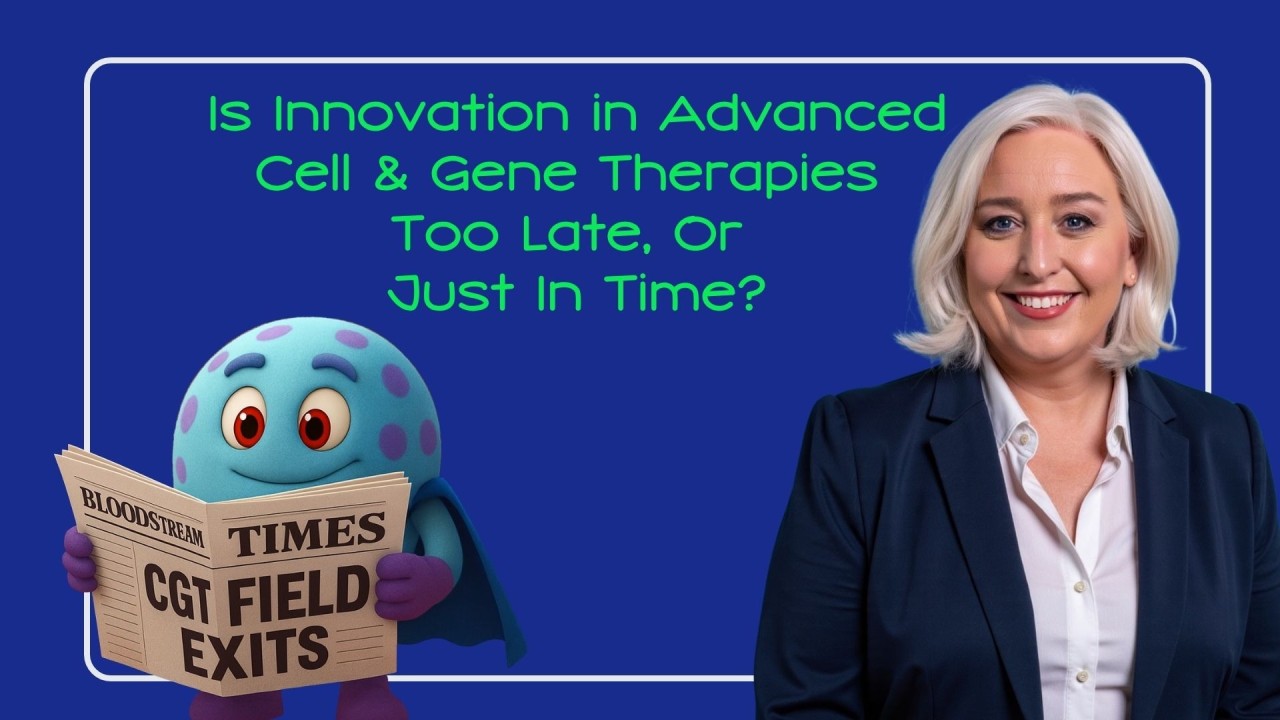
In recent weeks, Takeda, Galapagos, and Novo Nordisk all announced exits from the CGT field. These are major players with resources, talent, and strategic foresight. Their decisions sent ripples of concern—and left many of us asking:
Is Innovation for CGT late? Or just in time?
It’s a question worth sitting with. And it deserves a serious answer.
My Take – The Real Story is About Readiness
Yes, CGT is hard. It’s expensive. It’s operationally demanding. It takes time to coordinate across fragmented systems and global footprints.
But the idea that CGT is “too complex to scale” is a dangerous oversimplification. As an industry, we’ve built more capability in the last five years than in the previous two decades.
✔️ Donor and patient collection networks now span continents
✔️ Regulators are constructively engaging on decentralized models and COI traceability
✔️ Cross-functional collaboration—between CROs, CDMOs, hospitals, sponsors—is no longer theoretical
✔️ Patient advocacy is driving systemic change
We are not at the beginning anymore. We’re on the edge of transformation.
But we have to recognize this for what it is: a critical inflection point. If we misread temporary headwinds as fundamental flaws, we risk stepping back just as CGT is becoming real, reachable, and ready.
And even as the field evolves toward allogeneic and in vivo platforms, we can’t forget: the infrastructure we’ve built through autologous CGTs is foundational.
From chain-of-identity to clinical workflow design to patient/provider engagement—this is the groundwork every next-generation modality will build upon.
Commitment To Patients: We’re Not Slowing Down—We’re Accelerating Innovation
It’s tempting to read the recent CGT exits and conclude that the momentum is fading. But behind the scenes—and in plain sight—some of the most meaningful innovation in advanced therapies is happening right now.
Not in splashy headlines, but in the trenches of what truly enables access and scale.
We’re seeing real progress in:
🧪 Assay Development: We’re not just validating tests—we’re rethinking how, when, and where assays are run. From accelerated lot release methods to decentralized QC approaches, we’re collapsing timelines without compromising rigor.
⚙️ Manufacturing Methods: The field is moving beyond bespoke, one-patient-at-a-time workflows. We’re seeing co-development of platformized, closed, and automated manufacturing systems that reduce operator burden, increase reliability, and shrink facility footprints.
💰 Cost Control Measures: Cost is a design constraint, so as a field we’re embedding process analytics, digital twins, and modular scale-out strategies to drive down COGs while improving reproducibility and compliance.
🔄 Technology Transfer and CMC Acceleration CMC is no longer just a bottleneck—it’s a strategic lever. We’re building systems that standardize tech transfer, align early process development with commercial endpoints, and reduce variability across sites and batches.
These aren’t speculative moonshots. These are practical, deployable advances being built by cross-functional teams who understand that science isn’t enough—delivery matters.
We’re not pausing. We’re pressing forward—with intention, with urgency, and with each other. With You!
A Milestone in Access, Not Just Innovation
The Mobile Leukapheresis Center isn’t just a new type of bloodmobile. It’s a practical solution to three of CGT’s most persistent—and solvable—access challenges:
- Place: Brings capability into communities, reducing the travel burden on patients and donors—especially those in rural or underserved regions.
- Knowledge: Each deployment builds local expertise, streamlines SOPs, and helps sites adopt CGT delivery by removing the logistical barriers of procurement.
- Affordability: By reducing complexity and enabling scheduling flexibility, the MLC lowers costs and unlocks new geographies—making more trials feasible and commercial models more sustainable.
And most importantly, it’s not a one-organization win. It’s the product of clinical, regulatory, operational, and community collaboration. This is what real progress looks like.
First Ofs Are Not the Last Ofs—They’re Momentum Builders
In CGT, we celebrate “firsts”: First patient dosed. First site activated. First product approved. But we too often treat those firsts as finish lines.
“First ofs” are not the last ofs. They are momentum builders.
They are templates for others to follow. They are confidence signals for teams on the brink. They are proof that barriers can be moved, models can evolve, and systems can change.
But only if we share them, learn from them, and build upon them—together.
When we treat firsts as isolated wins, we lose momentum. When we treat them as inflection points, we build something bigger.
This Is Our Moment to Scale Hope
Patients aren’t asking for perfection. They’re asking for presence. For us to keep moving. To act even when conditions aren’t ideal—because they never are.
Hope doesn’t scale unless we do.
If we want CGT to reach its potential, we must:
- ✅ Celebrate firsts with intention: Not for vanity—but to inspire others to act.
- ✅ Turn wins into blueprints: Processes, protocols, digital tools—these are the products of progress.
- ✅ Bridge silos across the ecosystem: From vein to vein, every function shapes the patient experience.
- ✅ Move urgently—together: Speed, grounded in quality, isn’t a risk. It’s a responsibility.
Let’s Not Let Another Program Die in Silence
Too many CGT programs don’t fail because of science. They fail because the system around them wasn’t ready.
- ❌ Sites untrained
- ❌ Collections delayed
- ❌ Budgets unsustainable
- ❌ Timelines slipped too far
Every failed program is a lost patient, a discouraged team, a postponed breakthrough. And the ripple effects are real—dampening momentum across the entire field.
But it doesn’t have to be this way.
What’s Your Next First?
What “first of” is your team working on right now? What milestone—big or small—might unlock clarity, courage, or commitment for someone else?
Let’s stop treating progress like it has to be perfect to be shared. Let’s build the future of advanced therapies one milestone at a time—together.
We’re not too late. We’re just in time. But only if we keep showing up, aligning, and moving forward—Together.
Reach out to me or the team at BBG Advanced Therapies to explore how we can help move faster, smarter, and more equitably.