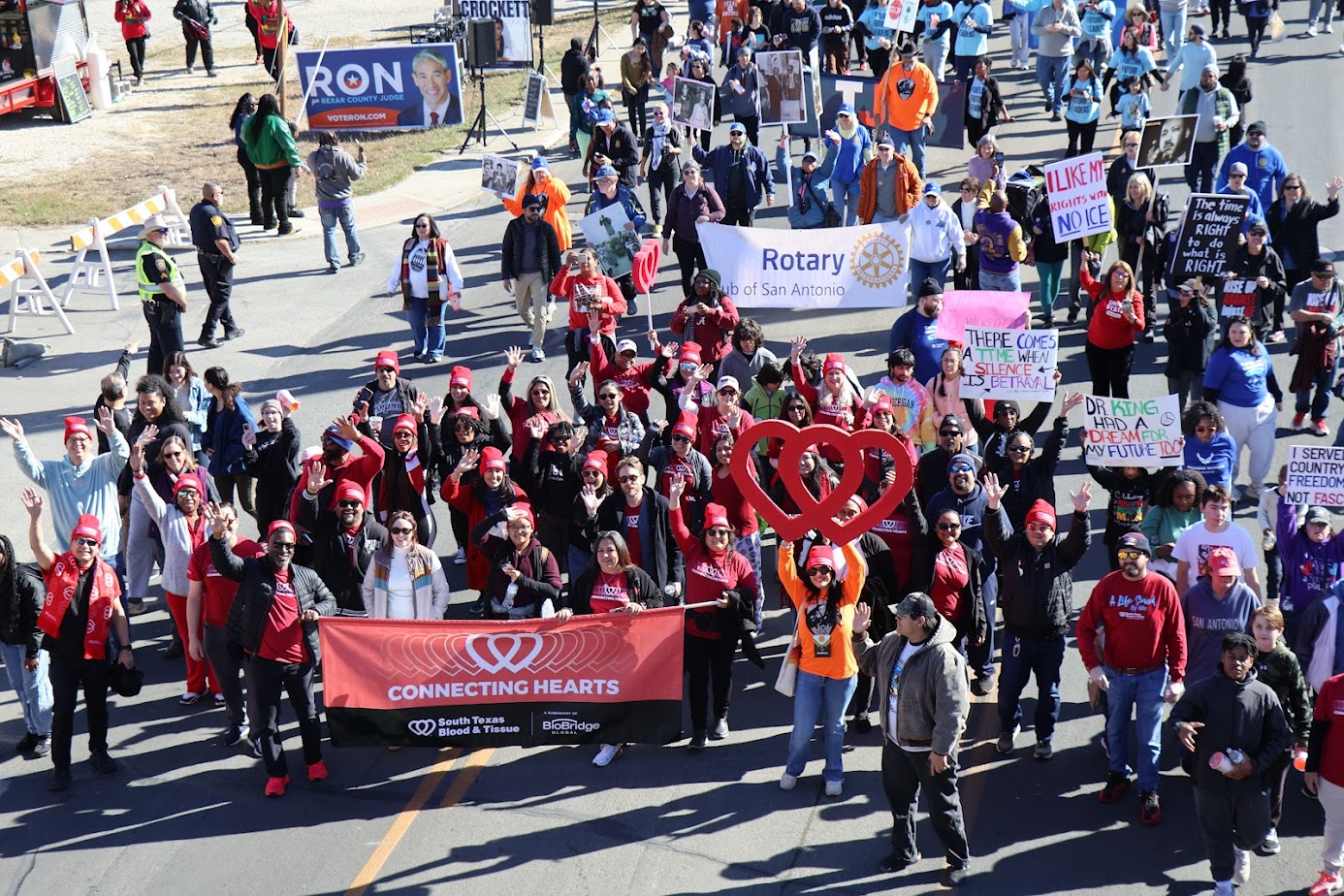
Before sunrise on MLK Day, more than 50 BioBridge Global staff members gathered in downtown San Antonio to take part in the city’s annual MLK Day March in San Antonio — marking the largest group of BBG employees ever to participate in the historic event.
What began as a cool early morning quickly turned into a powerful display of unity. Staff members marched together through the city’s streets, surrounded by thousands of participants from across the community. Families pushed strollers, community groups carried banners, volunteers handed out water, and neighbors cheered from the sidelines. The atmosphere was one of encouragement, respect, and shared purpose.
BBG employees proudly walked alongside community partners, including Connecting Hearts, capturing moments, exchanging high fives, and embracing the spirit of service that defines the day. Even local law enforcement officers along the route were welcoming, supportive, and committed to ensuring a safe and positive experience for all.
BioBridge Global employees gather in front of the South Texas Blood & Tissue donor bus during the MLK Day March in San Antonio.
The march was more than a tradition; it was a visible reminder of what can happen when a community comes together with intention.
Every step taken side by side represented BBG’s ongoing commitment to unity, service, and meaningful engagement beyond the workplace.
Participation matters. And on this MLK Day, BBG made history not just in numbers, but in proving that living out our values happens not only inside our organization, but in the heart of our community.
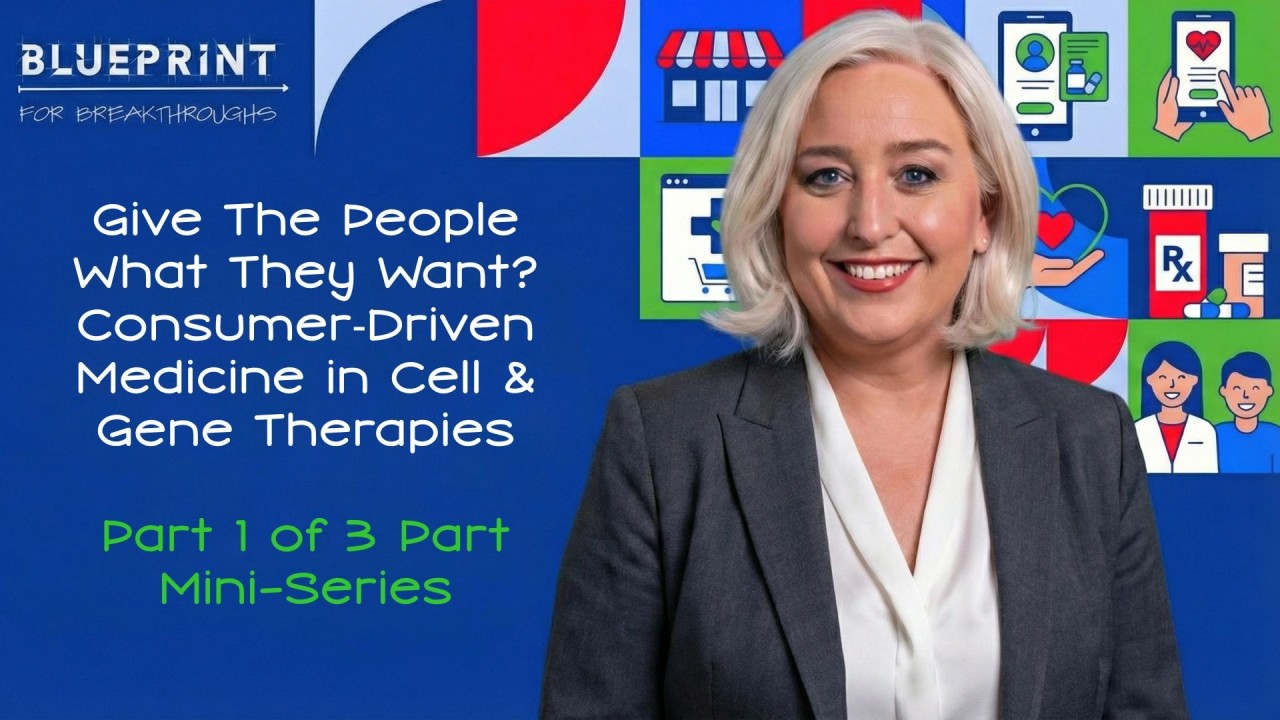
Blueprint for Breakthroughs is a LinkedIn newsletter published by Adrienne B. Mendoza, MHA, SVP BioBridge Global and Chief Operating Officer (COO), BBG Advanced Therapies
There is a growing dissonance at the heart of modern medicine. On one hand, the science of cell and gene therapy is now capable of resetting immune systems, transforming outcomes for certain malignancies, and changing the trajectory of some rare diseases. On the other hand, many patients (and even their providers) still experience these therapies as rare, distant, and administratively exhausting rather than as a realistic option in their own care.
At the same time, parts of healthcare delivery are changing far more quickly. For example, access models for some GLP‑1 therapies for chronic disease now include:
Retail pharmacies with specialty and refrigerated delivery
Telehealth services that bundle consults, prescribing, and follow‑up
Cash‑pay or subscription offerings that, in some cases, feel simpler—and even cheaper up front—than traditional, insurance‑driven pathways
These models are not perfect, and I’m not arguing that they’re a template for high‑risk advanced therapies. They do, however, demonstrate how logistics, price transparency, and navigation can be reconfigured when there is pressure and willingness to do so.
The Real Gap: Science vs Systems
The question is whether the systems around patient access to these medicines are ready for the incoming demand.
Today’s CGT access still depends on structures that were built for a different era of medicine:
Coverage and benefit design built around traditional medicine, not the nature of these products
Referral patterns optimized for episodic procedures, not longitudinal patient and drug-product journeys
Site capacity and staffing models tuned to “business as usual,” not complex logistics, starting material coordination (leukapheresis/apheresis), infusion, and long‑term monitoring
Care coordination workflows designed for static prescriptions, not for therapies that move between collection centers, manufacturing sites, and treatment facilities
This is the gap patients feel: not in the promise of the science, but in the friction of the pathway.
The Constraints on Clinicians and Health Systems
Clinicians and health‑system leaders are not standing still; they are working inside very real constraints:
Staff shortages and burnout in traditional healthcare delivery settings
Financial pressure and razor‑thin margins at many community hospitals and practices
Growing consolidation or affiliation with larger corporate entities and distributors
Complex ownership and contracting arrangements that may, in practice, favor established high‑volume drugs over disruptive new modalities
Policy advocates and professional groups have raised concerns about how some of these dynamics could affect the adoption of innovation, but the exact impact is still being debated. What is clear is that building the infrastructure, staffing, and financial models required for cell therapy is hard to do on top of these competing pressures.
Therapies That Don’t Fit Neatly in Legacy Care
Cell and gene therapies’ challenge long‑standing assumptions about where and how care happens. For each patient, someone has to solve for:
Starting material – collecting cells at the right time, in the right condition, from the right patients and donors for ex-vivo produced therapies
Manufacturing – coordinating complex, time‑sensitive processes often across geographies
Risk management – preparing sites to manage acute toxicities and post‑infusion complications
Long‑term follow‑up – tracking outcomes and safety over years, not months
These needs do not fit neatly into legacy structures focused on one‑time procedures or chronic prescriptions. Yet there are emerging examples that point toward more flexible ways of organizing this work:
Mobile and community‑based collection initiatives that bring leukapheresis closer to where patients live
Closer collaboration between community oncology practices and specialized centers to share responsibility for CAR‑T and CGT access
Integrated testing and manufacturing models that tighten the loop between starting material, release testing, and final product administration
These are early signals that the “rails” for cell therapy could be laid out differently.
What This Series Will Explore
The purpose of this series is not to declare that retail or technology companies will “take over” cell therapy, nor to diminish the central role of hospitals and community care. It is to ask a more nuanced, forward‑looking question:
As new access models take shape at the edges of healthcare, will the future of cell therapy be designed primarily within existing systems, or will significant parts of that future be built around them?
To answer that, this three‑part series in Blueprint for Breakthroughs will:
Part 1 (this article): Name the tension between scientific readiness and delivery reality, and frame the core question.
Part 2: Look more concretely at how GLP‑1, retail, and digital care models are restructuring access—where their design patterns are relevant to cell and gene therapy, and where comparisons may be appropriate, vs. misleading or unsafe.
Part 3: Explore how a more patient‑centered, shared approach could look if health systems, community clinicians, advanced therapy partners, and newer entrants choose to collaborate rather than compete over who builds the path to these treatments.
The goal is not to promote any one solution, but to surface the design choices ahead of us—so that advanced cell and gene therapies do not remain boutique miracles but become accessible options for patients everywhere.
We use cookies to ensure that we give you the best experience on our website. If you continue to use this site we will assume that you are happy with it.