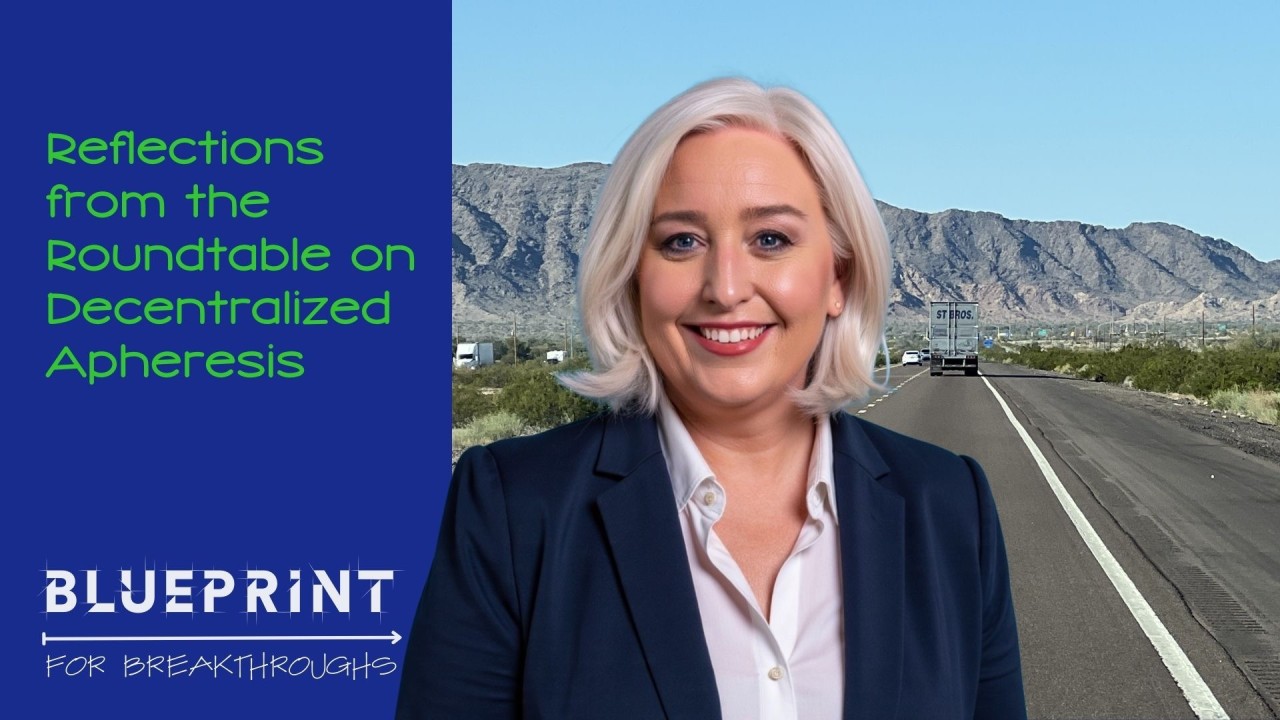
Blueprint for Breakthroughs is a LinkedIn newsletter published by Adrienne B. Mendoza, MHA, SVP BioBridge Global and Chief Operating Officer (COO), BBG Advanced Therapies
Originally published on LinkedIn on February 17, 2026
The Long Way West
We left San Antonio before the sun had fully committed to the sky. About nine hours later — by nightfall — we were in El Paso, still in Texas.
A full day of driving, and it seemed the road only stretched longer ahead.
The Mobile Leukapheresis Center carried us west, rolling steady and deliberate. The first fully self-contained apheresis center on wheels, crossing miles of highway that once took pioneers months to traverse. The horizon stretched wide. The sky refused to end. The land felt patient.
The next morning brought New Mexico. Then Arizona. Desert light turned copper and gold. The climb toward the Sierra Nevada range was gradual at first, then undeniable. And then, almost suddenly, we dropped down into San Diego — the Pacific air shifting the temperature and the mood. We’d arrived for Advanced Therapies Week to exhibit the Mobile Center and discuss the path it will drive on for patients to access life-saving medicine.
Four states. Desert crossings. Mountain passes. More than a thousand miles.
It was hard not to acknowledge the irony that it was a journey across the American West – a frontier journey — for the frontier of medicine.
When the Map Is Incomplete
The early maps of the American West were ambitious — and deeply incomplete. Rivers ended mid-line. Mountain ranges drifted in the wrong direction. Entire territories were left blank.
Explorers had little evidence to go off of, simply because information had not yet been shared. Each westward expansion charted what it could see. It took time — and collaboration — before those partial drawings were layered into something navigable.
Advanced therapies feel like that today, because like all frontiers – we believe a better future is out there, but the future is still being mapped.
Each stakeholder holds knowledge about a part of the terrain. Pharmaceutical manufacturers understand how to move the drug through complex orchestrated controls, biotech drug developers know the science, clinicians know the patient history, and so on…But here’s the reality – the patient, like an early explorer, travels across all of them. And when those maps don’t align, the burden of stitching them together falls on the patient and those helping them navigate the journey, if they are lucky to be joined by help.
A Roundtable Convened
That realization is why I wanted to host the roundtable at Advanced Therapies Week. Not simply to talk about decentralized apheresis as an operational innovation. It was to bring diverse perspectives into one room — pharma and biotech leaders, academic investigators, clinicians, patient advocates, operational partners — and begin layering our maps together.
The room was packed. And what stood out was a real appetite to build this future collaboratively, and to do so, with the patient in mind.
We had to start by acknowledging something fundamental: Expanding infrastructure without coordinating navigation risks multiplying complexity.
What Decentralized Apheresis Unlocks
Apheresis — the collection of cells separated from the blood — is the manufacturing input for many advanced therapies. Seen through a supply-chain lens, it is upstream manufacturing. While it carries no immediate therapeutic value for the patient, the patient must move through this crucial step to receive their therapy.
That reframing changes the design conversation.
Community and regional collection sites — fixed or mobile — can bring the starting point closer to where people live. Sponsors can contract directly with qualified collection providers as part of their supply chain strategy. Authorized treatment centers can focus on complex infusion, toxicity management, and long-term follow-up.
In infrastructure terms, decentralized apheresis transforms a handful of single-lane roads into a network.
But as we talked, a shared caution surfaced: how do we build that network in a way that truly bridges the divide?
The Human Element of Terrain
On paper, the journey to advanced therapy appears orderly.
- Referral leads to workup.
- Workup leads to collection.
- Collection leads to manufacturing.
- Manufacturing leads to infusion.
- Infusion leads to follow-up.
But real journeys do not move in straight lines.
For the patient — or the parent / caregiver — each step often arrives as a separate moment of uncertainty. A new voice on the phone. A new portal login. A new acronym that carries weight but little explanation. One day it’s eligibility criteria. The next it’s insurance authorization. Then a scheduling window tied to manufacturing capacity. Then lab results that may or may not shift the timeline.
Each person involved is trying to help. From inside of the system, even if coordination seems seamless, there needs to be a recognition that from the outside — especially when fear is present — it can be fragile. Patients repeat their stories. They wonder whether they misunderstood something. They worry that a missed email or delayed callback could close a door.
And the journey does not end at infusion…There are weeks of monitoring. Months of follow-up. Scans that reopen anxiety.
And for some, the journey never begins at all… Capacity limits. Geographic distance. Financial strain. Timing. Clinical exclusion. The map does not always lead to treatment.
Historian Patricia Nelson Limerick once described the American frontier as:
“A place of risk, improvisation, and uneven outcomes.”
That phrase lingers…Risk. Improvisation. Uneven outcomes.
If decentralized apheresis expands access geographically, navigation must evolve alongside it. Like a new map drawn together from all those early explorers.
- Shared language across institutions.
- Designed handoffs between organizations.
- Visibility across the full journey.
- Success measured by coherence of experience.
- Drawing the Map — Together
If there is one provocative truth I carried home from San Diego, it is this:
Breakthrough science without breakthrough systems is not a breakthrough.
We can approve therapies. We can scale manufacturing. We can expand indications. But if patients still feel like they are crossing a frontier without a map, we have more work to do.
The roundtable reminded me that no single organization can chart this terrain alone. What gave me real hope was not just the conversation — it was the posture in the room.
There was not a single person present who was not committed to working together. Industry leaders. Clinicians. Advocates. Operators.
Different perspectives. Shared focus.
The session was standing-room only, and for those who were unable to stay or couldn’t get a seat, thank you for your patience. We clearly underestimated the appetite for this conversation — and next time, we will make sure there is more room.
Because this discussion cannot be a one-time exchange. It must be ongoing cartography.
Closing Thoughts and an Invitation
If you attended and have additional reflections, or if you are reading this and see gaps we haven’t yet named, I invite you to add your voice. What should we be thinking about as we map this future together? Where are the blind spots? Where are the opportunities?
Frontiers are dangerous when information is isolated. They become navigable when knowledge is shared.
I am deeply grateful to everyone who showed up, spoke candidly, and leaned into collaboration. Your insights — and your willingness to own your piece of the terrain — give me (and I hope you!) genuine optimism about what we can build.
The mountains are still there. But the map is ours to draw.
Let’s draw it well.