
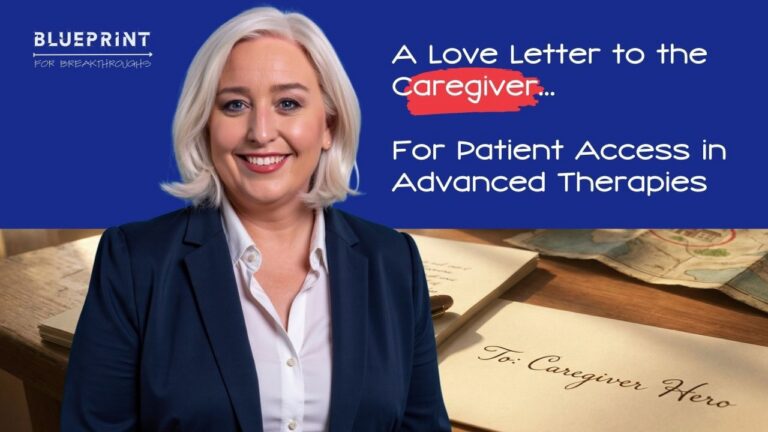
Blueprint for Breakthroughs is a LinkedIn newsletter published by Adrienne B. Mendoza, MHA, SVP BioBridge Global and Chief Operating Officer (COO), BBG Advanced Therapies
Originally published on LinkedIn on February 24, 2026
Dear Caregiver,
Your name does not appear in the efficacy tables. You are not captured in the cost-effectiveness analysis. You do not show up in the commercial forecast.
And yet, without you, many patients would never receive cell or gene therapy.
Ask anyone who has completed a transplant-like cellular treatment how they made it through. Their answer will include someone like you. A person who rearranged their life for 30 days or more. Someone who stayed within one hour of a hospital because the rules required it. Someone who monitored for fever, confusion, tremor. Someone who learned that when “something feels off,” it is time to call — immediately.
You may be a spouse. You may be a sibling. You may be an adult child. You may be a friend who stepped forward when family could not.
Not everyone has someone like you. And that reality matters, because caregiver availability and capability can influence eligibility.
You are not simply a source of comfort. You are written into monitoring plans and discharge checklists. Your vigilance reduces risk. Your presence enables access.
You are already part of the clinical architecture. You are the co-investigator behind every durable response. And yet, you should not have to be heroic for the system to function.
As a system, we need to commit to changing that for future patients.
With Love,
When “standard of care” depends on unpaid labor
The clinical rationale is clear. Advanced therapies carry real risks. Early detection of toxicity saves lives. Close observation matters.
But when we require a 24/7 caregiver for 30 days within geographic proximity to a tertiary center, we are not only setting a clinical standard. We are setting a social one.
According to AARP and the National Alliance for Caregiving, more than 50 million Americans provide unpaid care to loved ones with health needs. Oncology research consistently documents caregiver financial toxicity: lost wages, reduced work hours, career disruption, long-term economic strain. Now layer onto that the expectation that someone can pause their life for a month, potentially relocate, remain within one hour of a hospital, and assume responsibility for high-acuity symptom monitoring.

In many CGT programs today, identifying a caregiver is not optional. It’s actually written into the protocols and perscribing plan. Patients are commonly required to designate a responsible adult who can remain with them 24 hours a day for at least 30 days after infusion. Institutional education materials outline the caregiver’s responsibilities clearly: monitor for signs of CRS and ICANS, manage medications, coordinate appointments, and ensure rapid escalation if symptoms arise. Some professional guidance even recommends assessing caregiver capacity — the ability to drive, to remain available around the clock, to be reliable — as part of determining whether a patient is an appropriate candidate.
For some families, that is possible.
For others, it is destabilizing.
And for some patients, it is impossible.
Not every caregiver is a spouse or immediate family member. Sometimes it is an adult child rearranging work. Sometimes it is a sibling flying in from another state. Sometimes it is a friend who steps forward because no one else can. And sometimes there is no one at all.
When caregiver identification becomes a prerequisite to therapy, those realities matter.
“No caregiver, no CGT” may not be printed in bold in the brochure — but operationally, it can become true.
That has implications not only for equity, but for commercial scale.
When the miracle comes with a map and no directions
Cell and gene therapies promise a lot: one time. Durable. Life-changing.
But they often arrive bundled with a logistics plan that assumes a level of support many families simply do not have.
The journey usually looks something like this:
- Awareness and diagnosis: Navigating specialists, genetic testing, and rare-disease language that feels like another planet.
- Initiation: Wrestling with prior authorization, benefits verification, and coverage criteria that extend beyond the label.
- Treatment administration: Traveling to an academic center, arranging lodging, staying nearby for weeks “just in case.”
- Post-treatment monitoring: Labs, scans, symptom diaries, 24/7 vigilance for side effects like CRS or neurotoxicity.
- Survivorship and after: Trying to return to normal when nothing about work, finances, or emotional reserves feels normal anymore.
Every step assumes someone is there — to drive, to sit, to monitor, to interpret instructions, to miss work, to keep the household running.
When that “someone” does not exist — or is already stretched beyond capacity — the miracle becomes theoretical.

The commercialization constraint we rarely model
In boardrooms and investor decks, adoption curves, manufacturing capacity, authorized treatment center expansion, and reimbursement dynamics are carefully modeled.
Rarely is caregiver availability.
Yet if every treated patient requires a 24-hour caregiver for 30 days within one hour of a certified center, caregiver capacity becomes a gating factor in market penetration.
It shapes who can say yes. It influences geographic reach. It affects socioeconomic diversity. It constrains real-world uptake.
A therapy that depends on extraordinary unpaid labor will scale differently than one that does not.
Some professional guidance documents recommend assessing caregiver capacity as part of determining patient eligibility.
If caregiver presence is structurally required and structurally unsupported, access will naturally cluster among families with financial flexibility, employment protection, and social capital. Patients who live alone, who are geographically isolated, or whose networks are already stretched will face a higher barrier — regardless of clinical eligibility.
That is not just an ethical issue. It is a commercial one.
A patchwork is not a system
There are supports in place. Manufacturer-aligned HUB programs provide education, travel coordination, and 24/7 access lines. Specialty pharmacy programs include caregiver outreach. Nonprofits offer travel and lodging grants. Cancer organizations publish caregiver guides and practical toolkits.
These efforts matter, and they reflect genuine commitment.
But most are logistical and educational. They do not replace a month of lost wages. They do not mitigate employment risk. They do not systematically resource what the protocol requires.
CGT developers have, in effect, declared caregivers essential infrastructure — and then treated them as external to the system.
A design question, not a gratitude exercise
If caregivers are truly required for safety — and in many cases they are — then the responsibility does not end at “identify one.”
It extends to redesign.
There are only two intellectually honest paths forward.
The first is to reduce caregiver dependence wherever it can be done safely: decentralize monitoring when clinically appropriate, expand community-based capacity, leverage remote monitoring technologies, and reevaluate geographic proximity requirements as evidence evolves.
The second is this: if caregiver presence remains essential, then formally recognize and resource it. Embed predictable travel and lodging support. Explore structured caregiver stipends or wage-replacement mechanisms. Incorporate caregiver burden into reimbursement discussions. Treat caregiver support as part of the therapy’s delivery cost — not as a charitable add-on.
If we are willing to reimburse six-figure therapies, but unwilling to acknowledge the unpaid labor that enables their safe delivery, we are not fully accounting for the cost of care.
And if we ignore this constraint, it will most certainly limit access and adoption.
One simple ask this week
If you are designing a trial, writing a coverage policy, planning a network, or building an access program, try this:
Before you finalize anything, picture the caregiver in the second seat.
Would they say, “We can do this,” or “There is no way”?
If it is the latter, we still have work to do.
If this resonated, share it with someone who has sat in that caregiver seat — or someone designing the systems so that we stop taking them for granted.

Sources & Context
- AARP & National Alliance for Caregiving, Caregiving in the U.S.
- Institutional CAR-T patient education materials (e.g., Dana-Farber, MSKCC)
- Published literature on financial toxicity in oncology
- Professional guidance on CAR-T patient eligibility and caregiver requirements