
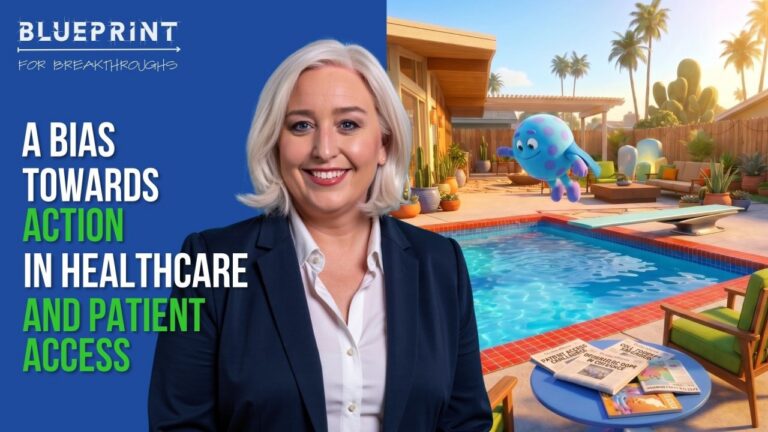
Blueprint for Breakthroughs is a LinkedIn newsletter published by Adrienne B. Mendoza, MHA, SVP BioBridge Global and Chief Operating Officer (COO), BBG Advanced Therapies
Originally published on LinkedIn on April 21, 2026
There’s a number that stays with me: $22,000.
That’s one of the estimates for the out-of-pocket burden that a patient, plus their caregiver has for travel, lodging, and lost wages when the nearest cell and gene therapy treatment center is 200 miles away. That’s 66,000,000 Americans today. For many of the patients who need these therapies, that distance is the difference between access and no other option.
I think about that number a lot. I think about how those who’ve been through this vouch that it’s a low estimate and it’s part of why I keep working on problems I don’t yet have all the answers to — questions about reimbursement structures I’m still learning, contracting models I’m pressure-testing, and network designs I’m building in real time alongside people smarter than me in those lanes. The goal can feel out of reach. But a goal worthy of working toward usually does.
The industry is facing headwinds right now. That’s not going away anytime soon. We can let that reality write another season of reasons why now isn’t the right moment — or we can decide that, within those constraints, we still have enormous power to choose in favor of the future.
On Monday, I was listening to The Daily Fire by high-performance coach Brendon Burchard, who talked about taking “the next right action of integrity.” Not the perfect move, not the someday-when-it’s-easier move — the next one that’s aligned with the future you say you want.
That idea has been sitting with me as I keep circling one question:
Why aren’t more local and regional treatment centers part of the story in patient access for cell and gene therapies?
When I say treatment centers, I mean community oncology practices, regional health systems, hospitals, and specialty infusion clinics — the places where patients could actually receive care.PlayTuffy, the hero immune cell reads the news about Patient Access challenges in Cell and Gene therapy, and considers the impact on patient and caregiver lives (and finances).
Where My Thinking Started — and Where It’s Gone
For the last few years, my mental model was simple: access was mostly an infrastructure problem. More collection, more testing, more manufacturing, and the map would fill in.
I still believe infrastructure is foundational. But staying with this question has shown me something else too: the field is already technically capable of reaching more patients than it currently does. The friction isn’t one thing — it’s many, and they compound.
A Few of the Frictions I Keep Seeing
- Vague roles. Most treatment centers outside major metros don’t have a clear picture of what “participation” could mean for them. Full CGT center of excellence? Referral hub? Spoke site? When the role isn’t legible, staying out feels safer than stepping in.
- Working‑capital risk. For hospital‑based programs especially, purchasing high‑cost therapies and waiting on unpredictable reimbursement is not theoretical — it’s existential. A single denied or delayed claim can ripple through a regional system in ways a large academic enterprise can absorb.
- Moving policy ground. CMS access models, PBM‑defined networks, and value‑based constructs keep evolving. Long‑term program commitments are hard to justify when the rules of the game may shift before the first patient is infused.
- Long‑term follow‑up expectations. Multi‑year monitoring obligations are essential — and rarely explained in a way that community practices can operationalize without feeling overwhelmed.
- Legacy messaging. For years, the field has signaled — implicitly and explicitly — that complex innovation lives at the big centers. Many treatment‑center leaders internalized that message. Some are still living inside it.
Any one of these is solvable. Together, they create enough drag that even well‑intentioned leaders have trouble navigating to help move things forward.
Building the Stairs
Think about it this way: when a treatment center looks at CGT participation, the industry has largely offered two options — jump into the deep end and become a full center of excellence, or stand at the side and watch. What the industry hasn’t done well enough is build the stairs.
Becoming a referral hub, or a spoke site to a hub — those are the stairs. They let a center enter the water at a depth that matches its current capacity, build confidence, and wade deeper over time. Not every center needs to reach the deep end. But every center deserves a way in.

My “Updated” Bias for Action
At BBG Advanced Therapies, we’ve invested in infrastructure: mobile and fixed‑site leukapheresis, advanced analytics and testing, clinical research support, and cGMP manufacturing under FDA/EMA and PMDA aligned quality systems.
That’s still foundational. What I’m adding is a clearer bias toward action around the middle of the network:
- Designing realistic roles for treatment centers outside major metros — not asking every site to become a flagship, but helping each find the lane it can drive safely.
- Translating complexity — turning CMS rules, contracting structures, and working‑capital realities into language that leaders can actually act on.
- Prototyping in real places — using Texas, with its scale, diversity, and access deserts, as a living laboratory instead of treating “community” and “rural” as abstract talking points.
- Staying in the questions — not pretending we have all the answers, but refusing to let open questions become reasons not to move.
The mission is bigger than any one organization’s playbook. My commitment is to keep choosing in favor of the future patients deserve — one honest step at a time.
An Invitation to Join Me
I’ll be hosting a live webinar on this topic this week, on Thursday and I look forward to you joining.
The Webinar: “Building the Cell and Gene Therapy Access Network Together is for clinicians, treatment‑center leaders, sponsors, and payers who are ready to move past the headwinds and start designing something more usable for the middle of the network. We’ll:
- Name the real frictions honestly, without pretending any single solution fixes them all.
- Explore where infrastructure can help the equation.
- Ask what a first, concrete step toward participation could look like for more treatment centers.
We won’t solve everything in one conversation. But we’ll do something more important: take the next right action together.
The next chapter of cell and gene therapy won’t be written by flagship centers alone. It will be written by the treatment centers the industry hasn’t fully designed for yet — and by the people willing to summon their best and keep moving forward anyway.
If that resonates with where you are in your own work, I’d be honored to have you in that conversation.
🔗 Recording link: https://www.linkedin.com/events/7448191794623746048?viewAsMember=true