
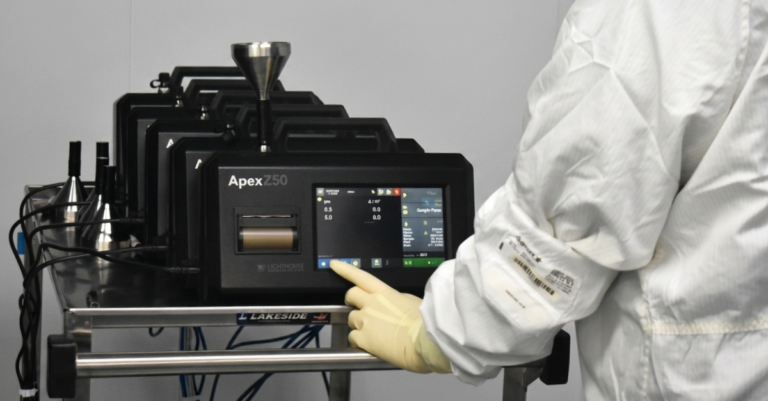
Why Non-Viable Particle Counters Are Critical for Contamination Control
Cleanroom technology continues to evolve as industries face stricter regulatory requirements, higher product quality expectations, and increasing pressure to reduce contamination risks. Whether in pharmaceutical manufacturing, biotechnology, medical devices, semiconductors, or aerospace, maintaining controlled environments is essential.
This article explains what non-viable particle counters are, how they work, why they matter in cleanroom environments, and how organizations can choose the right technology for their contamination control strategy.
At the center of modern cleanroom monitoring are non-viable particle counters, which provide real-time measurement of airborne particles that can compromise product quality, process integrity, and compliance.
What Is a Non-Viable Particle Counter?
A non-viable particle counter is a monitoring instrument used to detect and count airborne particles in a controlled environment without determining whether those particles are living (microbial) or non-living, such as:
- Dust
- Skin flakes
- Fibers
- Aerosols
- Process-generated particulates
- Environmental contaminants
Unlike viable monitoring systems that are designed to detect living microorganisms, non-viable particle counters detect particles based on their size and quantity.
These systems are essential for ensuring compliance with cleanroom classifications such as:
- ISO 14644
- EU GMP Annex 1
- FDA cleanroom standards
Why Are Particle Counters Important in Cleanrooms?
Cleanrooms are designed to provide a controlled environment and minimize contamination. Even microscopic particles can:
- Contaminate injectable drugs
- Impact sterile manufacturing
- Reduce product shelf life
- Cause batch failures
- Trigger regulatory findings
Non-viable particle counters help facilities:
- Provide real time data
- Detect drifts from established operating conditions
- Verify HVAC and filtration performance
- Monitor cleanroom classification compliance
- Support environmental monitoring programs
- Reduce downtime and product loss
Real-time monitoring allows operators to respond immediately before contamination becomes a larger issue.
How Non-Viable Particle Counters Work
Most modern particle counters use laser-based optical particle counting technology.
The Process
- Air is drawn into the instrument.
- Particles pass through a laser beam.
- Light scattering occurs when particles interrupt the beam.
- Sensors measure the scattered light.
- The system calculates particle size and concentration.
The results are typically displayed as:
- Particles per cubic meter
- Particles per cubic foot
- Particle size distribution
Common measured particle sizes include:
- ≥0.5 µm
- ≥5.0 µm
Key Technologies in Modern Cleanroom Particle Monitoring
1. Real-Time Continuous Monitoring for all production fillings
Modern cleanrooms increasingly rely on continuous monitoring systems instead of periodic manual sampling.
Benefits include:
- Immediate contamination alerts
- Trend analysis
- Reduced human intervention
- Better process control
- Automated reporting
Continuous systems are especially important in aseptic processing environments.
Applications of Non-Viable Particle Counters
Pharmaceutical Manufacturing
In sterile drug production, particle monitoring is essential for:
- Aseptic filling
- Compounding
- Cleanroom qualification
- GMP compliance
EU GMP Annex 1 emphasizes continuous non-viable monitoring in Grade A areas during critical operations and risk-based monitoring for Grade B, C and D areas.
BBG Advanced Therapies facilities use particle counters to protect our partners science including:
- Cell cultures
- Biologics manufacturing
- Gene therapy production
Sensitive biologic products require highly controlled environments.
Frequently Asked Questions
What is the difference between viable and non-viable particle monitoring?
Non-viable monitoring measures airborne particulate matter, while viable monitoring detects living microorganisms such as bacteria and fungi.
Why is continuous particle monitoring important?
Continuous monitoring provides real-time contamination detection, allowing facilities to respond quickly before product quality is affected.
BBG Advanced Therapies, subsidiary of BioBridge Global, has maintained a commitment to quality since opening in 2025. BBG Advanced Therapies leverages the BioBridge Global enterprise quality management and electronic batch records.
Having this access to expert quality teams advance programs from early development through clinical evaluation and toward commercialization.
Authors: Suvarchala Syamala, Quality Control Technician, Angelica Padilla Perez Manager, Quality & Compliance, and Brooklyn Wilkinson, Digital Experience Manager
For access to a comprehensive biomanufacturing service organization Contact us.